
- HOME
- News & Events
- Publications
- 【Publications】Suppressing glutamate dehydrogenase guides hematopoietic stem cell divisions into self...
Publications
【Publications】Suppressing glutamate dehydrogenase guides hematopoietic stem cell divisions into self-renewal
September 16 2026
Published date
05 September 2026
Lab
Terumasa Umemoto
Authors
Michihiro Hashimoto, Michie Uchikawa , Yuichiro Arima , Akiyasu Iwase , Ayano Yahagi , Mizuki Ishimaru , Tomomasa Yokomizo , Ayako Nakamura-Ishizu , Yosuke Tanaka , Kenichi Miharada , Hiroki Kurihara ,Goro Sashida , Toshio Suda, and Terumasa Umemoto
Title
Suppressing glutamate dehydrogenase guides hematopoietic stem cell divisions into self-renewal
Journal information
Nature Communications
doi: 10.1038/s41467-026-77151-6
URL: https://www.nature.com/articles/s41467-026-77151-6
Abstract
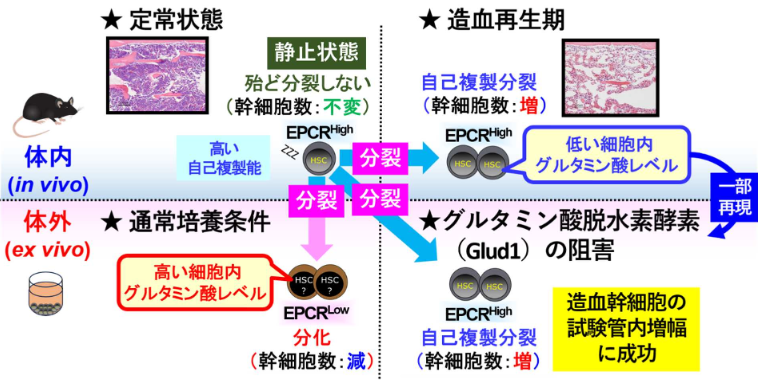
Hematopoietic stem cells (HSCs) self-renew to expand their pool but often differentiate upon division. Thus, it remains unclear how HSCs maintain their stemness during or after division. Here, we show that the suppression of glutamate dehydrogenase (Glud1), a key enzyme responsible for glutamate (Glu) catabolism, supports the maintenance of HSCs during division. We find that self-renewing mouse HSCs during hematopoietic regeneration exhibited lower intracellular Glu levels compared to HSCs differentiating during ex vivo culture. We therefore focus on the negative regulation of Glu catabolic reactions as a candidate factor to maintain HSCs during division, and find that treatment with the Glud1 inhibitor, R162, maintains a subset of HSCs that would otherwise differentiate during division under normal culture conditions. This treatment successfully results in an approximately 500-fold expansion of functional mouse HSCs that maintain expression pattern of conventional stem cell markers over a 30-day culture period. Importantly, this positive effect of Glud1 inhibition is independent of suppressing cell divisions and dependent on robust JAK2-STAT signaling. Overall, our findings propose that Glud1 inhibition, coupled with robust JAK2-STAT signaling, characterizes a functional HSC state during division, enabling ex vivo expansion of mouse HSCs under conventional culture conditions.
Graphical Abstract
Press Release
KumamotoUniversityWebsite(Japanese)

