- HOME
- News & Events
- [Dec.15] D5 Seminar - Dr. Alejandro Aguilera Castrejon (Howard Hughes Medical Institute Janelia Rese...
News & Events
[Dec.15] D5 Seminar - Dr. Alejandro Aguilera Castrejon (Howard Hughes Medical Institute Janelia Research Campus)
November 25 2026
The "D5 Medical & Life Science Seminar" course will be offered by International Research Center for Medical Sciences (IRCMS). It will run from May 2026 to March 2027, with lectures given by scientists who are affiliated with IRCMS or in collaboration with researchers at IRCMS. The lectures will be given once a month, in English, and by leading scientists in the relevant research field. Students will be taught: 1) how normal physiological functions are maintained in the human body; 2) how these systems become abnormal under certain pathophysiologic conditions; 3) why stem cells are important in animal development and homeostasis; 4) how stem cell-based approaches can help us understand disease mechanisms and find potential cure for diseases related to stem cell malfunction (e.g., cancer, aging).
All Kumamoto University members are welcome to participate.
For students who have registered for the course, please check your attendance in Moodle.
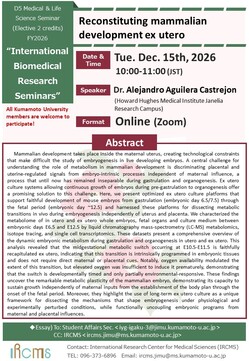
Date : Tue. Dec. 15th, 2026
Format : Online (Zoom)
Time : 10:00-11:00 (JST)
Speaker : Dr. Alejandro Aguilera Castrejon (Howard Hughes Medical Institute Janelia Research Campus)
Title : Reconstituting mammalian development ex utero
Abstract :
Mammalian development takes place inside the maternal uterus, creating technological constraints that make difficult the study of embryogenesis in live developing embryos. A central challenge for understanding the role of metabolism in mammalian development is discriminating placental and uterine-regulated signals from embryo-intrinsic processes independent of maternal influence, a process that until now has remained inseparable during gastrulation and organogenesis. Ex utero culture systems allowing continuous growth of embryos during pre-gastrulation to organogenesis offer a promising solution to this challenge. Here, we present optimized ex utero culture platforms that support faithful development of mouse embryos from gastrulation (embryonic day 6.5/7.5) through the fetal period (embryonic day ~12.5) and harnessed these platforms for dissecting metabolic transitions in vivo during embryogenesis independently of uterus and placenta. We characterized the metabolome of in utero and ex utero whole embryos, fetal organs and culture medium between embryonic days E6.5 and E12.5 by liquid chromatography mass-spectrometry (LC-MS) metabolomics, isotope tracing, and single cell transcriptomics. These datasets present a comprehensive overview of the dynamic embryonic metabolism during gastrulation and organogenesis in utero and ex utero. This analysis revealed that the midgestational metabolic switch occurring at E10.5-E11.5 is faithfully recapitulated ex utero, indicating that this transition is intrinsically programmed in embryonic tissues and does not require direct maternal or placental cues. Notably, oxygen availability modulated the extent of this transition, but elevated oxygen was insufficient to induce it prematurely, demonstrating that the switch is developmentally timed and only partially environmental-responsive. These findings uncover the remarkable metabolic plasticity of the mammalian embryo, demonstrating its capacity to sustain growth independently of maternal inputs from the establishment of the body plan through the onset of the fetal period. Moreover, they highlight the use of long-term ex utero culture as a unique framework for dissecting the mechanisms that shape embryogenesis under physiological and experimentally perturbed conditions, while functionally uncoupling embryonic programs from maternal and placental influences.
Major papers:
- A Ex utero mouse embryogenesis from pre-gastrulation to late organogenesis.
https://www.nature.com/articles/s41586-021-03416-3 - Post-gastrulation synthetic embryos generated ex utero from mouse naive ESCs.
https://www.sciencedirect.com/science/article/pii/S0092867422009813?via%3Dihub - Reconstituting Mouse Embryogenesis Ex Utero from Gastrulation to Fetal Development Reveals Maternally Independent Metabolic Programs.
https://www.biorxiv.org/content/10.64898/2026.03.17.710314v1
Flyer (click to enlarge)