- HOME
- News & Events
- [Oct.2] D5 Seminar - Dr. Hiroki Ueda (The University of Tokyo)
News & Events
[Oct.2] D5 Seminar - Dr. Hiroki Ueda (The University of Tokyo)
September 25 2026
The "D5 Medical & Life Science Seminar" course will be offered by International Research Center for Medical Sciences (IRCMS). It will run from May 2026 to March 2027, with lectures given by scientists who are affiliated with IRCMS or in collaboration with researchers at IRCMS. The lectures will be given once a month, in English, and by leading scientists in the relevant research field. Students will be taught: 1) how normal physiological functions are maintained in the human body; 2) how these systems become abnormal under certain pathophysiologic conditions; 3) why stem cells are important in animal development and homeostasis; 4) how stem cell-based approaches can help us understand disease mechanisms and find potential cure for diseases related to stem cell malfunction (e.g., cancer, aging).
All Kumamoto University members are welcome to participate.
For students who have registered for the course, please check your attendance in Moodle.
Date : Fri. Oct. 2nd, 2026
Format : Hybrid (IRCMS lounge & Zoom)
Time : 16:00-17:00 (JST)
Speaker : Dr. Hiroki Ueda
Professor, Graduate School of Medicine, The University of Tokyo
Title : Why and How Do We Sleep?
-Exhausted Information Transfer Mechanism for Slow-wave Oscillations-
Abstract :
Sleep remains one of the greatest remaining mysteries. At the Sleep 2012 conference, we conceived a shift from the concept of "sleep substances" to "wake substances" such as calcium, suggesting that sleep homeostasis may arise from the integration of wake-related activity. Inspired by Dr. Setsuro Ebashi's work on calcium signaling, we investigated calcium's role in sleep regulation. Using our Triple-CRISPR method (Sunagawa et al. 2016), we screened 25 genes related to calcium channels and pumps, revealing calcium as a brake on brain activity to promote sleep (Tatsuki et al. 2016). We also developed a tissue-clearing method CUBIC (Susaki et al. 2014; Tainaka et al. 2014); (Yamashita et al. 2026); (Yoshida et al. 2026)) to visualize calcium's effects on neural circuits. Further work showed that calcium-dependent enzymes, CaMKIIα/β kinases, act as calcium "memory" devices, with phosphorylation sites controlling sleep onset, duration, and termination (Tone et al. 2022). Other direct and indirect calcium-dependent phosphatases, Calcineurin and PP1 (sleep-promoting), and opposing kinases, PKA (wake-promoting), function as synaptic sleep switches (Wang et al. 2024). These findings lead us to propose the Phosphorylation Hypothesis of Sleep Homeostasis, in which sleep pressure is encoded by reversible phosphorylation states of synaptic and neuronal proteins. During wakefulness, Ca²⁺-dependent enzymes such as CaMKII may integrate prior neural activity through a phosphorylation-based "count-up" mechanism, increasing the drive toward sleep. Conversely, Ca²⁺-dependent phosphatases such as calcineurin may mediate a dephosphorylation-based "count-down" mechanism, resetting sleep pressure during sleep. We also identified the ryanodine receptor 1, a calcium channel, as a molecular target of inhalational anesthetics, hinting at shared pathways between anesthesia and sleep (Kanaya et al. 2025).
In this symposium, we also discuss that EXhausted Information Transfer (EXIT) at pre- and post-synapses may underlie slow-wave oscillations. Prolonged wakefulness may weaken synaptic information transfer through reduced presynaptic release, vesicle resources, and postsynaptic efficacy, thereby promoting synchronized NREM-like activity. We further propose NREM Similarity in Wake as a quantitative measure of sleepiness. Wake EEG that becomes more similar to NREM sleep may reflect reduced wakefulness level and increased local sleep pressure. Consistently, presynaptic impairment increases NREM similarity in wake, whereas presynaptic enhancement decreases it.
Finally, we introduce Wake Inhibition Sleep Enhancement (WISE), a hypothesis that wakefulness disconnects neural networks, whereas NREM sleep reconnects them (Kinoshita et al. 2025). Together, the Phosphorylation Hypothesis, EXIT, NREM Similarity, and WISE provide a unified framework linking calcium-dependent phosphorylation, synaptic exhaustion, slow-wave oscillations, sleepiness, and the restorative function of sleep.
Major papers:
1. Kanaya, Hiroyuki J., Ken Kuwajima, Yuko Ito, Yuta Shinohara, Yohei Okubo, Shinnosuke Shiono, Fumiya Tatsuki, et al. 2025. "Isoflurane Activates the Type 1 Ryanodine Receptor to Induce Anesthesia in Mice." PLoS Biology 23 (6): e3003172.
2. Kinoshita, Fukuaki L., Rikuhiro G. Yamada, Koji L. Ode, and Hiroki R. Ueda. 2025. "A Unified Framework to Model Synaptic Dynamics during the Sleep-Wake Cycle." PLoS Biology 23 (6): e3003198.
3. Sunagawa, Genshiro A., Kenta Sumiyama, Maki Ukai-Tadenuma, Dimitri Perrin, Hiroshi Fujishima, Hideki Ukai, Osamu Nishimura, et al. 2016. "Mammalian Reverse Genetics without Crossing Reveals Nr3a as a Short-Sleeper Gene." Cell Reports 14 (3): 662-77.
4. Susaki, Etsuo A., Kazuki Tainaka, Dimitri Perrin, Fumiaki Kishino, Takehiro Tawara, Tomonobu M. Watanabe, Chihiro Yokoyama, et al. 2014. "Whole-Brain Imaging with Single-Cell Resolution Using Chemical Cocktails and Computational Analysis." Cell 157 (3): 726-39.
5. Tainaka, Kazuki, Shimpei I. Kubota, Takeru Q. Suyama, Etsuo A. Susaki, Dimitri Perrin, Maki Ukai-Tadenuma, Hideki Ukai, and Hiroki R. Ueda. 2014. "Whole-Body Imaging with Single-Cell Resolution by Tissue Decolorization." Cell 159 (4): 911-24.
6. Tatsuki, Fumiya, Genshiro A. Sunagawa, Shoi Shi, Etsuo A. Susaki, Hiroko Yukinaga, Dimitri Perrin, Kenta Sumiyama, et al. 2016. "Involvement of Ca(2+)-Dependent Hyperpolarization in Sleep Duration in Mammals." Neuron 90 (1): 70-85.
7. Tone, Daisuke, Koji L. Ode, Qianhui Zhang, Hiroshi Fujishima, Rikuhiro G. Yamada, Yoshiki Nagashima, Katsuhiko Matsumoto, et al. 2022. "Distinct Phosphorylation States of Mammalian CaMKIIβ Control the Induction and Maintenance of Sleep." PLoS Biology 20 (10): e3001813.
8. Wang, Yimeng, Siyu Cao, Daisuke Tone, Hiroshi Fujishima, Rikuhiro G. Yamada, Rei-Ichiro Ohno, Shoi Shi, et al. 2024. "Postsynaptic Competition between Calcineurin and PKA Regulates Mammalian Sleep-Wake Cycles." Nature 636 (8042): 412-21.
9. Yamashita, Katsunari, Fukuaki L. Kinoshita, Shota Y. Yoshida, Katsuhiko Matsumoto, Tomoki T. Mitani, Hiroshi Fujishima, Yoichi Minami, et al. 2026. "A Whole-Brain Single-Cell Atlas of Circadian Neural Activity in Mice." Science (New York, N.Y.) 391 (6787): eaea3381.
10. Yoshida, Shota Y., Katsuhiko Matsumoto, Satoshi Takagi, Fukuaki L. Kinoshita, Katsunari Yamashita, Daichi Shigeta, Yoshichika Yoshioka, et al. 2026. "Whole-Organ and Whole-Body 3D Atlases Enable Cellome-Wide Profiling." Cell 189 (6): 1836-1853.e19.
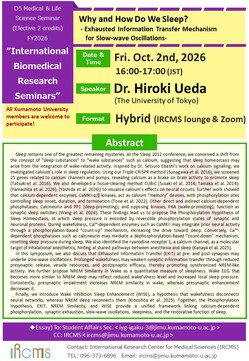
Flyer (click to enlarge)