- HOME
- News & Events
- [Sep.2] D5 Seminar - Dr. Koji Hase (The University of Tokyo)
News & Events
[Sep.2] D5 Seminar - Dr. Koji Hase (The University of Tokyo)
August 5 2026
The "D5 Medical & Life Science Seminar" course will be offered by International Research Center for Medical Sciences (IRCMS). It will run from May 2026 to March 2027, with lectures given by scientists who are affiliated with IRCMS or in collaboration with researchers at IRCMS. The lectures will be given once a month, in English, and by leading scientists in the relevant research field. Students will be taught: 1) how normal physiological functions are maintained in the human body; 2) how these systems become abnormal under certain pathophysiologic conditions; 3) why stem cells are important in animal development and homeostasis; 4) how stem cell-based approaches can help us understand disease mechanisms and find potential cure for diseases related to stem cell malfunction (e.g., cancer, aging).
All Kumamoto University members are welcome to participate.
For students who have registered for the course, please check your attendance in Moodle.
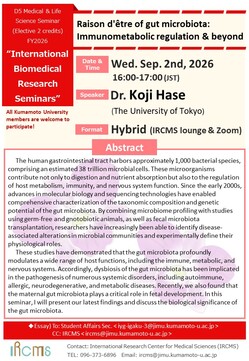
Date : September 2nd, 2026 (Wednesday)
Format : Hybrid (IRCMS lounge & Zoom)
Time : 16:00 - 17:00 (JST)
Speaker : Dr. Koji Hase (The University of Tokyo)
Title : Raison d'être of gut microbiota: Immunometabolic regulation & beyond
Abstract :
The human gastrointestinal tract harbors approximately 1,000 bacterial species, comprising an estimated 38 trillion microbial cells. These microorganisms contribute not only to digestion and nutrient absorption but also to the regulation of host metabolism, immunity, and nervous system function. Since the early 2000s, advances in molecular biology and sequencing technologies have enabled comprehensive characterization of the taxonomic composition and genetic potential of the gut microbiota. By combining microbiome profiling with studies using germ-free and gnotobiotic animals, as well as fecal microbiota transplantation, researchers have increasingly been able to identify disease-associated alterations in microbial communities and experimentally define their physiological roles.
These studies have demonstrated that the gut microbiota profoundly modulates a wide range of host functions, including the immune, metabolic, and nervous systems. Accordingly, dysbiosis of the gut microbiota has been implicated in the pathogenesis of numerous systemic disorders, including autoimmune, allergic, neurodegenerative, and metabolic diseases. Recently, we also found that the maternal gut microbiota plays a critical role in fetal development. In this seminar, I will present our latest findings and discuss the biological significance of the gut microbiota.
Major papers:
1. Kimura I and Hase K et al, Maternal gut microbiota in pregnancy influences offspring metabolic phenotype. Science, 367: eaaw8429, 2020.
2. Nagai M and Hase K et al., Fasting-refeeding impacts immune cell dynamics and mucosal immune responses. Cell 178: 1072-1087, 2019.
3. Furusawa Y and Hase K et al., Commensal microbe-derived butyrate induces colonic regulatory T cells. Nature 504: 446-450, 2013.
Flyer (click to enlarge)