- HOME
- News & Events
- [July.15] D5 Seminar - Dr. Carlos Lois (California Institute of Technology, USA)
News & Events
[July.15] D5 Seminar - Dr. Carlos Lois (California Institute of Technology, USA)
July 6 2026
The "D5 Medical & Life Science Seminar" course will be offered by International Research Center for Medical Sciences (IRCMS). It will run from May 2026 to March 2027, with lectures given by scientists who are affiliated with IRCMS or in collaboration with researchers at IRCMS. The lectures will be given once a month, in English, and by leading scientists in the relevant research field. Students will be taught: 1) how normal physiological functions are maintained in the human body; 2) how these systems become abnormal under certain pathophysiologic conditions; 3) why stem cells are important in animal development and homeostasis; 4) how stem cell-based approaches can help us understand disease mechanisms and find potential cure for diseases related to stem cell malfunction (e.g., cancer, aging).
All Kumamoto University members are welcome to participate.
For students who have registered for the course, please check your attendance in Moodle.
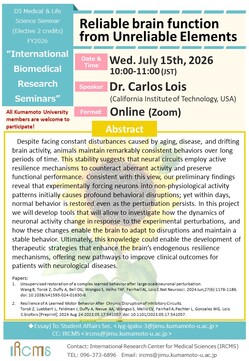
Date : July 15th, 2026 (Wednesday)
Format : Online (Zoom)
Time : 10:00 - 11:00 (JST)
Speaker : Dr. Carlos Lois (California Institute of Technology, USA)
Title : Reliable brain function from Unreliable Elements
Abstract :
Despite facing constant disturbances caused by aging, disease, and drifting brain activity, animals maintain remarkably consistent behaviors over long periods of time. This stability suggests that neural circuits employ active resilience mechanisms to counteract aberrant activity and preserve functional performance. Consistent with this view, our preliminary findings reveal that experimentally forcing neurons into non-physiological activity patterns initially causes profound behavioral disruptions; yet within days, normal behavior is restored even as the perturbation persists. In this project we will develop tools that will allow to investigate how the dynamics of neuronal activity change in response to the experimental perturbations, and how these changes enable the brain to adapt to disruptions and maintain a stable behavior. Ultimately, this knowledge could enable the development of therapeutic strategies that enhance the brain's endogenous resilience mechanisms, offering new pathways to improve clinical outcomes for patients with neurological diseases.
Major papers:
Wang B, Torok Z, Duffy A, Bell DG, Wongso S, Velho TAF, Fairhall AL, Lois C. "Unsupervised restoration of a complex learned behavior after large-scale neuronal perturbation. " Nat Neurosci. 2024 Jun;27(6):1176-1186. doi: 10.1038/s41593-024-01630-6.
Torok Z, Luebbert L, Feldman J, Duffy A, Nevue AA, Wongso S, Mello CV, Fairhall A, Pachter L, Gonzalez WG, Lois C. "Resilience of A Learned Motor Behavior After Chronic Disruption of Inhibitory Circuits." bioRxiv [Preprint]. 2024 Aug 24:2023.05.17.541057. doi:10.1101/2023.05.17.541057.
Flyer (click to enlarge)