- HOME
- News & Events
- [June. 18] D5 Seminar - Dr. Azusa Inoue (RIKEN IMS)
News & Events
[June. 18] D5 Seminar - Dr. Azusa Inoue (RIKEN IMS)
June 5 2026
The "D5 Medical & Life Science Seminar" course will be offered by International Research Center for Medical Sciences (IRCMS). It will run from May 2026 to March 2027, with lectures given by scientists who are affiliated with IRCMS or in collaboration with researchers at IRCMS. The lectures will be given once a month, in English, and by leading scientists in the relevant research field. Students will be taught: 1) how normal physiological functions are maintained in the human body; 2) how these systems become abnormal under certain pathophysiologic conditions; 3) why stem cells are important in animal development and homeostasis; 4) how stem cell-based approaches can help us understand disease mechanisms and find potential cure for diseases related to stem cell malfunction (e.g., cancer, aging).
All Kumamoto University members are welcome to participate.
For students who have registered for the course, please check your attendance in Moodle.
Date : June 18th, 2026 (Thursday)
Format : Hybrid (IRCMS lounge and zoom)
Time : 10:00 - 11:00 (JST)
Speaker : Dr. Azusa Inoue (RIKEN IMS)
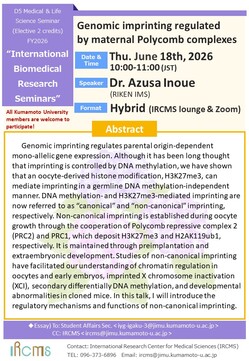
Title : Genomic imprinting regulated by maternal Polycomb complexes
Abstract :
Genomic imprinting regulates parental origin-dependent mono-allelic gene expression. Although it has been long thought that imprinting is controlled by DNA methylation, we have shown that an oocyte-derived histone modification, H3K27me3, can mediate imprinting in a germline DNA methylation-independent manner. DNA methylation- and H3K27me3-mediated imprinting are now referred to as "canonical" and "non-canonical" imprinting, respectively. Non-canonical imprinting is established during oocyte growth through the cooperation of Polycomb repressive complex 2 (PRC2) and PRC1, which deposit H3K27me3 and H2AK119ub1, respectively. It is maintained through preimplantation and extraembryonic development. Studies of non-canonical imprinting have facilitated our understanding of chromatin regulation in oocytes and early embryos, imprinted X chromosome inactivation (XCI), secondary differentially DNA methylation, and developmental abnormalities in cloned mice. In this talk, I will introduce the regulatory mechanisms and functions of non-canonical imprinting.
Major papers:
- Mei H, Kozuka C, Kumon M, Koseki H, and Inoue A. (2026) H2AK119ub1-MLL2 counteraction underlies heritable H3K27me3 formation in oocytes. Molecular Cell 86(9):1691-1707.
- Matsuwaka M, Kumon M, Inoue A. (2025) H3K27 dimethylation dynamics reveal stepwise establishment of facultative heterochromatin in early mouse embryos. Nature Cell Biology 27(1): 28-38.
- Mei H, Kozuka C, Hayashi R, Kumon M, Koseki H, Inoue A. (2021) H2AK119ub1 guides maternal inheritance and zygotic deposition of H3K27me3 in mouse embryos.Nature Genetics 53(4), 539-550.
Flyer (click to enlarge)