- HOME
- News & Events
- [Mar. 24] D5 Seminar - Dr. Daniel Lacorazza (Texas Children's Research Institute (TCRI))
News & Events
[Mar. 24] D5 Seminar - Dr. Daniel Lacorazza (Texas Children's Research Institute (TCRI))
March 16 2026
The "D5 Medical & Life Science Seminar" course will be offered by International Research Center for Medical Sciences (IRCMS). It will run from May 2025 to March 2026, with lectures given by scientists who are affiliated with IRCMS or in collaboration with researchers at IRCMS. The lectures will be given once a month, in English, and by leading scientists in the relevant research field. Students will be taught: 1) how normal physiological functions are maintained in the human body; 2) how these systems become abnormal under certain pathophysiologic conditions; 3) why stem cells are important in animal development and homeostasis; 4) how stem cell-based approaches can help us understand disease mechanisms and find potential cure for diseases related to stem cell malfunction (e.g., cancer, aging).
Anyone who wants to join is welcome.
For students who have registered for the course, please check your attendance in Moodle.
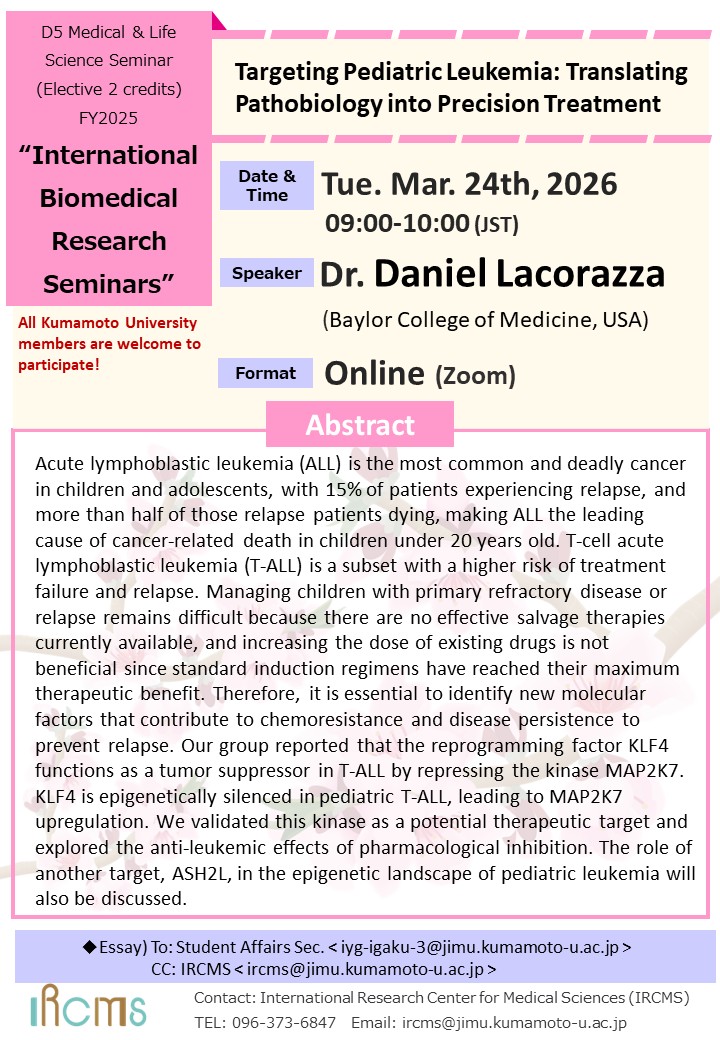
Date : March 24th, 2026 (Tuesday)
Format : Online (zoom)
Time : 9:00 - 10:00 (JST)
Speaker : Dr. Daniel Lacorazza (Texas Children's Research Institute (TCRI))
Title : Targeting Pediatric Leukemia: Translating Pathobiology into Precision Treatment
Abstract :
Acute lymphoblastic leukemia (ALL) is the most common and deadly cancer in children and adolescents, with 15% of patients experiencing relapse, and more than half of those relapse patients dying, making ALL the leading cause of cancer-related death in children under 20 years old. T-cell acute lymphoblastic leukemia (T-ALL) is a subset with a higher risk of treatment failure and relapse. Managing children with primary refractory disease or relapse remains difficult because there are no effective salvage therapies currently available, and increasing the dose of existing drugs is not beneficial since standard induction regimens have reached their maximum therapeutic benefit. Therefore, it is essential to identify new molecular factors that contribute to chemoresistance and disease persistence to prevent relapse. Our group reported that the reprogramming factor KLF4 functions as a tumor suppressor in T-ALL by repressing the kinase MAP2K7. KLF4 is epigenetically silenced in pediatric T-ALL, leading to MAP2K7 upregulation. We validated this kinase as a potential therapeutic target and explored the anti-leukemic effects of pharmacological inhibition. The role of another target, ASH2L, in the epigenetic landscape of pediatric leukemia will also be discussed.
Major Papers:
1- Shen, Y, Park, CS., Suppipat, K., Mistretta, T.A., Puppi, M., Horton, T., Rabin, K., Gray, N.S., Meijerink, J.P.P., and Lacorazza, H.D. Inactivation of KLF4 promotes T-cell acute lymphoblastic leukemia and activates the MAP2K7 pathway. Leukemia (2017), 31(6):1314-1324. PMID: 27872496
2- Cory S. Bridges, Taylor Chen, Monica Puppi, Karen Rabin, H. Daniel Lacorazza. Anti-leukemic properties of the MELK inhibitor OTSSP167 in T cell acute lymphoblastic leukemia. Blood Advances (2023) 14;7:422-435. PMID: 36399528
3- Kim DR, Orr MJ, Kwong AJ, Deibler KK, Munshi HH, Bridges CS, Chen TJ, Zhang X, Lacorazza HD, Scheidt KA. Rational design of highly potent and selective covalent MAP2K7 inhibitors. ACS Med Chem Lett. (2023) 14(5):606-613. PMID: 37197477