- HOME
- News & Events
- [Feb. 10] D5 Seminar - Dr. Yosuke Kurashima (Chiba University)
News & Events
[Feb. 10] D5 Seminar - Dr. Yosuke Kurashima (Chiba University)
January 7 2026
The "D5 Medical & Life Science Seminar" course will be offered by International Research Center for Medical Sciences (IRCMS). It will run from May 2025 to March 2026, with lectures given by scientists who are affiliated with IRCMS or in collaboration with researchers at IRCMS. The lectures will be given once a month, in English, and by leading scientists in the relevant research field. Students will be taught: 1) how normal physiological functions are maintained in the human body; 2) how these systems become abnormal under certain pathophysiologic conditions; 3) why stem cells are important in animal development and homeostasis; 4) how stem cell-based approaches can help us understand disease mechanisms and find potential cure for diseases related to stem cell malfunction (e.g., cancer, aging).
Anyone who wants to join is welcome.
For students who have registered for the course, please check your attendance in Moodle.
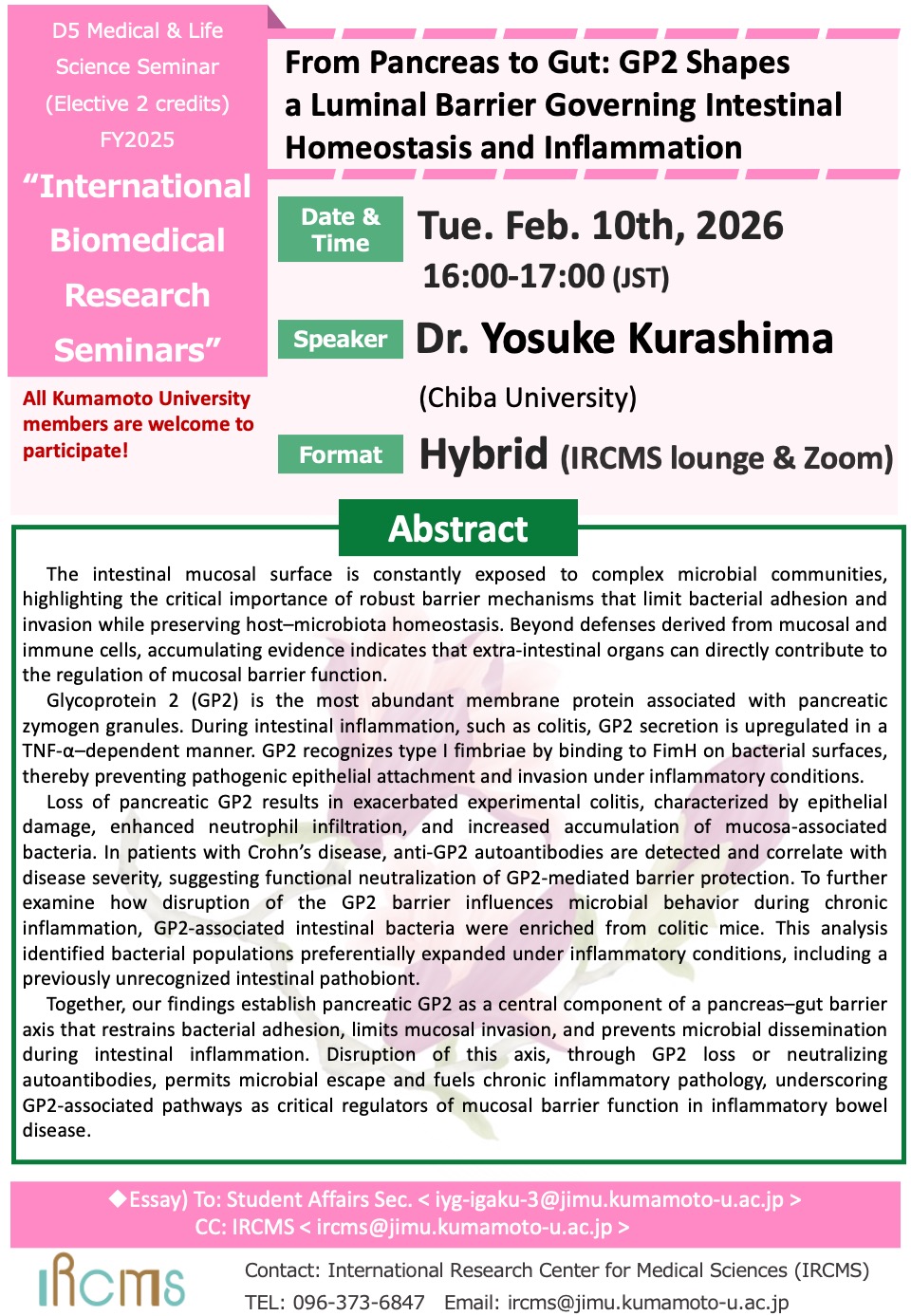
Date : February 10th, 2026 (Tuesday)
Format : Hybrid (IRCMS lounge and zoom)
Time : 16:00 - 17:00 (JST)
Speaker : Dr. Yosuke Kurashima (Chiba University)
Title : From Pancreas to Gut: GP2 Shapes a Luminal Barrier Governing Intestinal Homeostasis and Inflammation
Abstract :
The intestinal mucosal surface is constantly exposed to complex microbial communities, highlighting the critical importance of robust barrier mechanisms that limit bacterial adhesion and invasion while preserving host-microbiota homeostasis. Beyond defenses derived from mucosal and immune cells, accumulating evidence indicates that extra-intestinal organs can directly contribute to the regulation of mucosal barrier function.
Glycoprotein 2 (GP2) is the most abundant membrane protein associated with pancreatic zymogen granules. During intestinal inflammation, such as colitis, GP2 secretion is upregulated in a TNF-α-dependent manner. GP2 recognizes type I fimbriae by binding to FimH on bacterial surfaces, thereby preventing pathogenic epithelial attachment and invasion under inflammatory conditions.
Loss of pancreatic GP2 results in exacerbated experimental colitis, characterized by epithelial damage, enhanced neutrophil infiltration, and increased accumulation of mucosa-associated bacteria. In patients with Crohn's disease, anti-GP2 autoantibodies are detected and correlate with disease severity, suggesting functional neutralization of GP2-mediated barrier protection. To further examine how disruption of the GP2 barrier influences microbial behavior during chronic inflammation, GP2-associated intestinal bacteria were enriched from colitic mice. This analysis identified bacterial populations preferentially expanded under inflammatory conditions, including a previously unrecognized intestinal pathobiont.
Together, our findings establish pancreatic GP2 as a central component of a pancreas-gut barrier axis that restrains bacterial adhesion, limits mucosal invasion, and prevents microbial dissemination during intestinal inflammation. Disruption of this axis, through GP2 loss or neutralizing autoantibodies, permits microbial escape and fuels chronic inflammatory pathology, underscoring GP2-associated pathways as critical regulators of mucosal barrier function in inflammatory bowel disease.
Major Papers:
1. Kurashima Y, et al. Pancreatic glycoprotein 2 is a first line of defense for mucosal protection in intestinal inflammation. Nat Commun. 2021;12(1):1067.
2. Zhang Z, et al. Intestinal homeostasis and inflammation: Gut microbiota at the crossroads of pancreas-intestinal barrier axis. Eur J Immunol. 2022; 52(7):1035-1046.
3. Zhang Z, et al. Glycoprotein 2 as a gut gate keeper for mucosal equilibrium between inflammation and immunity. Semin Immunopathol. 2024;45(4-6):493-507.