
- HOME
- Education
- Student's Voice
- 【IRCMS Internship】Rimskaya Agnessa (Vavilov Institute of General Genetics)
Student's Voice

Name: Rimskaya Agnessa
Vavilov Institute of General Genetics
Visiting Period: September 8th (Mon), 2025 - October 31st (Fri), 2025
Country: Russia
Lab: Takahashi Lab
Q1. Summary of the internship (Description of the research conducted, aim, introduction of lab, and things you learned)
I have participated in a two-month internship program at IRCMS under the supervision of Takahashi-sensei. During this time the main goal was to study targeted methylation induction of CpG islands and epigenetic inheritance mechanisms using mouse model.
First of all, we established stable de novo DNA methylation in mouse embryonic stem cells (mESCs) for three generations using Takahashi-sensei's targeted methylation induction method by integration of CpG-free DNA. The chosen target loci were cytosine-phosphate-guanine (CpG) islands (CGIs) associated with metabolism-related genes such as Ankyrin repeat domain 26 (Ankrd26) and low-density lipoprotein receptor (Ldlr). To achieve this, I learned how to conduct bisulfite sequencing analysis using the following methods: gDNA purification, bisulfite conversion, PCR, bisulfite PCR, electrophoresis, and DNA extraction from agarose gel. We then sent the bisulfite-converted DNA samples for sequencing and analyzed the results using Quantification tool for Methylation Analysis (QUMA). Additionally, to prove stable methylation of Ldlr and Ankrd26 CGIs, we measured their gene expression levels. For this, I also learned how to perform RNA purification, reverse transcription and qPCR. Based on the qPCR results, we could also evaluate whether our mice were homozygous (double-stranded) or heterozygous (single-stranded) methylated.
Another part of the current research was to dive into the mechanisms of methylation induction and maintenance. We studied de novo methylated Ldlr CGI in mESCs (Ldlr_mESCs) treated with GSK-3484862, a DNMT1 inhibitor. We prepared three types of samples: Ldlr_mESCs treated with GSK for 10 days, Ldlr_mESCs treated with GSK for 10 days followed by 6 days without GSK, and control Ldlr_mESCs. Using bisulfite sequencing analysis, we determined that GSK-3484862 induces demethylation of the Ldlr CGI, but after its removal the methylation is restored. Moreover, we also performed DNA cloning into E. coli on LB plates with blue-white screening to estimate the methylation percentage of the Ldlr CGI at the TTAA allele, where TTAA is the target site used for inserting the CpG-free DNA. As a result, we obtained 96.5% methylation in control Ldlr_mESCs; for Ldlr_mESCs treated with GSK for 10 days the methylation percentage was 45.1%, and for Ldlr_mESCs treated with GSK for 10 days and then cultured without GSK for 6 days it was 79.1%.
It was also interesting to study histone lysine-to-methionine (K-to-M) mutants, such as H3K9M - an inhibitor of H3K9me3. To observe the effect of histones on methylation, Takahashi-sensei taught me how to perform Chromatin Immunoprecipitation Sequencing (ChIP-seq) and Western blotting. Theoretically, the H3K9M blocks normal H3K9me3 and therefore reduces DNA methylation. However, according to our results, we could not clearly demonstrate this effect and will need to conduct further research on the H3K9M mutant.
Last but not least, I also learned how to conduct immunocytochemistry and visualize proteins using fluorescent microscopy. With this approach, we successfully observed 3FLAG-tagged dCas9 and demonstrated that the CRISPR-dCas9 system is active in our cell samples. We also visualized the LDLR protein, and in samples with de novo methylation we could not detect the LDLR signal, but in the control, we saw LDLR localized at the cell membrane.
All in all, I learned a lot during my internship at IRCMS from Takahashi-sensei. And now I have hands-on experience with all the main molecular biology techniques to work with cells, DNA, RNA, and proteins, as well as visualization methods like fluorescence microscopy. I'm grateful that I had the opportunity to be part of Takahashi's lab and study such interesting research.
Q2. What did this experience do for you with respect to your specific career development directions?
This internship was especially valuable for me due to my interest in epigenetics. During this program, I learned the most important wet-lab methods and how to analyze data. It's also important to mention that we came up with some new ideas about epigenetic mechanisms and approaches for studying it more effectively for further research. So new projects and scientific discoveries are on the way!
During my internship, I was incredibly lucky to make so many new friends. We traveled to Amakusa several times, Aso and of course we explored Kumamoto. In Kumamoto mostly restaurants, but still! I also spent a lot of time with my dear colleagues during the internship, and I was happy to work and have fun together. And obviously, what is worth mentioning - the food in Japan is delicious!

Photo1: Visited Mount Aso

Photo2: Girls in Amakusa

Photo3:Kumamoto castle
Message to prospective students
I dare say that IRCMS is one of the most wonderful and promising international institutes in Japan! Here, you will never feel like a fish out of water. There are many international students, all seminars are held in English, and everyone is so friendly and attentive. It was very easy to kick-start my research and to settle into daily life.
So, dear students, I sincerely advise you to apply for the internship if you are interested in any IRCMS lab and don't be afraid of anything! You will be able to handle all the work, and even if you struggle, you will never be left alone with your problems.
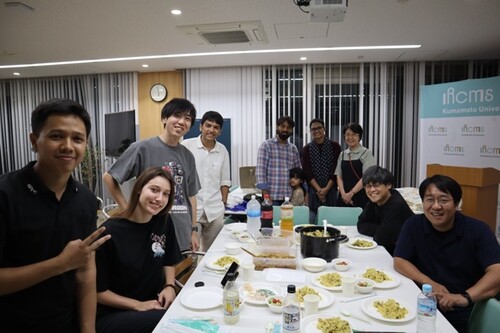
Photo4: Biryani Party with lab

